42 Bible Verses About Humility
Humility is not weakness, in Scripture it is the posture of those who see themselves accurately before an infinite God and choose to serve others above themselves.
Bible Verses
42
carefully curated passages
How to use this page
Read each verse with its context explanation. Bookmark the ones that speak to you and return often as your situation changes.
What the Bible Says About Humility
Humility is not weakness, in Scripture it is the posture of those who see themselves accurately before an infinite God and choose to serve others above themselves.
Proverbs 22:4 KJV
“By humility and the fear of the LORD are riches, and honour, and life.”
Context & Meaning
Solomon links humility and the fear of God as the twin root of a flourishing life, the person who is both lowly and God-fearing receives the fullest expression of divine blessing.
James 4:10 KJV
“Humble yourselves in the sight of the Lord, and he shall lift you up.”
Context & Meaning
James gives the great principle of spiritual reversal: self-abasement before God, not before people for show, is the condition God uses to exalt a person in His perfect time.
Philippians 2:3 KJV
“Let nothing be done through strife or vainglory; but in lowliness of mind let each esteem other better than themselves.”
Context & Meaning
Paul calls for a radical inversion of natural human ambition, choosing to genuinely regard others as more significant than oneself, modeled on the mind of Christ who left heaven's glory for a manger.
Matthew 23:12 KJV
“And whosoever shall exalt himself shall be abased; and he that shall humble himself shall be exalted.”
Context & Meaning
Jesus declares the permanent principle of God's kingdom: the direction of pride is downward, and the direction of humility is upward. Status in God's kingdom moves in the opposite direction from the world's.
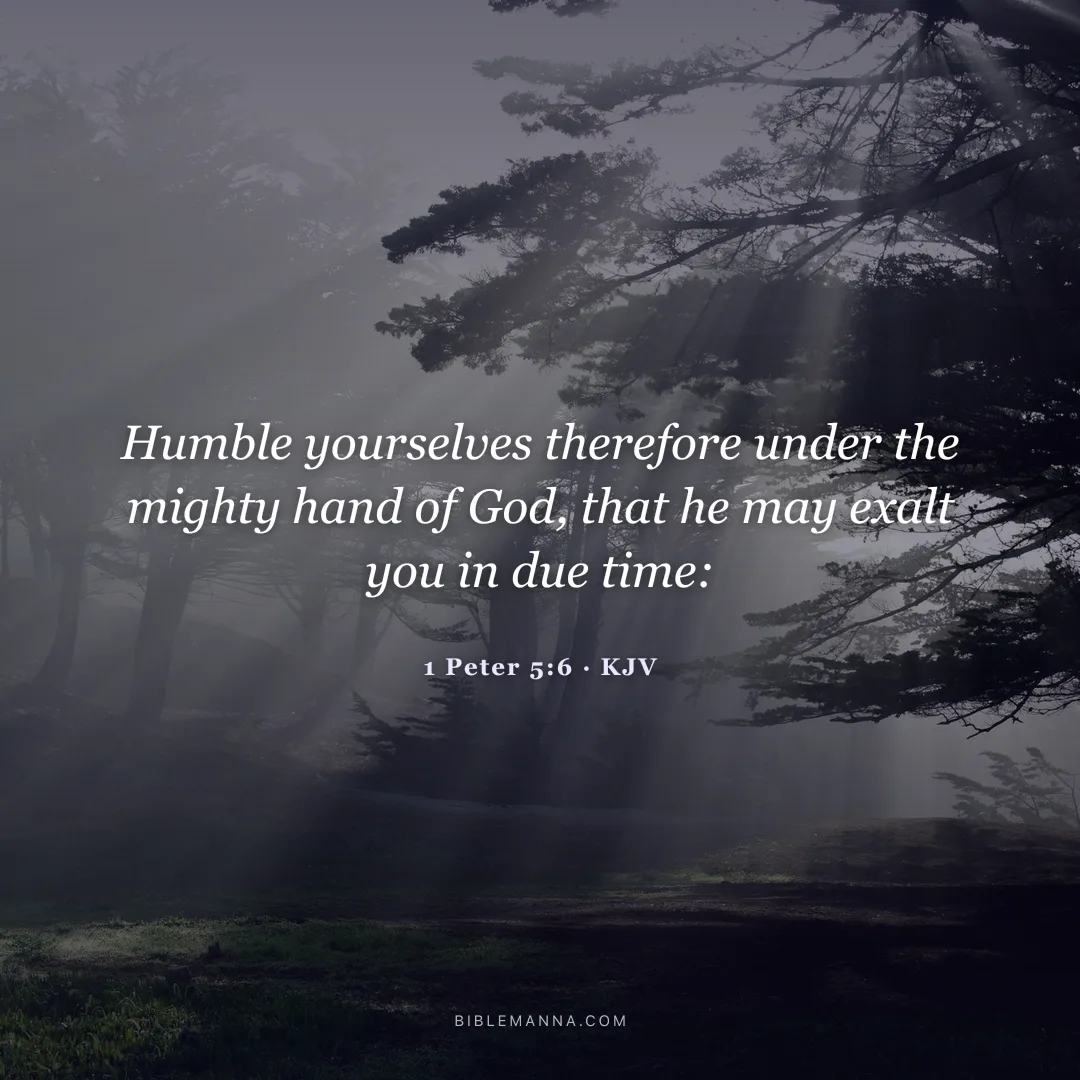
1 Peter 5:6 KJV
“Humble yourselves therefore under the mighty hand of God, that he may exalt you in due time.”
Context & Meaning
Peter adds the crucial phrase "in due time", humility is not immediately rewarded by the world, but God's exaltation comes at the appointed moment for those who remain lowly under His hand.
Micah 6:8 KJV
“He hath shewed thee, O man, what is good; and what doth the LORD require of thee, but to do justly, and to love mercy, and to walk humbly with thy God?”
Context & Meaning
God's three-part summary of the good life places walking humbly with God as its culmination, humility before God is not just one virtue among many but the foundation of a life that is just and merciful.
Matthew 18:4 KJV
“Whosoever therefore shall humble himself as this little child, the same is greatest in the kingdom of heaven.”
Context & Meaning
Jesus sets a child, socially powerless in the ancient world, as the measure of kingdom greatness. True humility means embracing dependence and lowliness without resentment or self-pity.
Proverbs 11:2 KJV
“When pride cometh, then cometh shame: but with the lowly is wisdom.”
Context & Meaning
Pride and wisdom cannot coexist, pride always ends in shame, while wisdom naturally accompanies the humble person who is teachable, open to correction, and realistic about their own limits.
Isaiah 66:2 KJV
“For all those things hath mine hand made, and all those things have been, saith the LORD: but to this man will I look, even to him that is poor and of a contrite spirit, and that trembleth at my word.”
Context & Meaning
God, who made everything, says He looks with special attention at the contrite and humble, the person of lowly, broken spirit has God's undivided attention in a way the proud never will.
Romans 12:3 KJV
“For I say, through the grace given unto me, to every man that is among you, not to think of himself more highly than he ought to think; but to think soberly, according as God hath dealt to every man the measure of faith.”
Context & Meaning
Paul defines humility precisely: sober, accurate self-assessment, not self-deprecation but clear-eyed honesty about what God has given and what He has not. True humility is realistic, not performative.
Frequently Asked Questions
What does the Bible say about humility?
The Bible presents humility as one of the most prized virtues in God's kingdom. God explicitly opposes the proud but gives grace to the humble (James 4:6). Jesus modeled humility perfectly (Matthew 11:29, Philippians 2:5-8). The consistent pattern throughout Scripture is that God exalts those who humble themselves (James 4:10, Matthew 23:12, 1 Peter 5:6). Micah 6:8 lists walking humbly with God as one of the three things God requires of His people.
What is the difference between humility and low self-esteem?
Biblical humility is not self-hatred or low self-worth, it is accurate self-assessment. Romans 12:3 defines it as thinking of yourself "soberly", neither inflated nor deflated, but realistically. Jesus, fully secure in His identity as the Son of God, demonstrated the deepest humility (Philippians 2:5-8). Humility knows its own value in God's eyes while freely choosing to serve and defer to others. Low self-esteem is a distortion; humility is clarity.
Why does God oppose the proud?
James 4:6 and 1 Peter 5:5 both quote Proverbs 3:34: "God resisteth the proud, but giveth grace unto the humble." Pride essentially tells God His input is not needed, it is self-sufficiency that bypasses dependence on Him. Isaiah 66:2 shows that God is drawn to the humble and contrite. Pride blocks the grace that only flows to those who acknowledge their need. It is not that God is offended by confidence, He is opposed to the self-deception of not needing Him.
What is a good Bible verse about humility for leadership?
Mark 10:43-44 is the definitive leadership text: "Whosoever will be great among you, shall be your minister: And whosoever of you will be the chiefest, shall be servant of all." Philippians 2:3-4 commands leaders to esteem others above themselves and look to others' interests. Jesus washing His disciples' feet (John 13:14-15) is the lived example. True biblical leadership is servant leadership, with humility as its defining characteristic.
How do I become more humble according to the Bible?
Scripture points to several pathways: spend time in God's presence (Isaiah 6:1-5, encountering God produces humility naturally), serve others actively (Philippians 2:3-4), practice honest self-assessment (Romans 12:3), receive correction without defensiveness (Proverbs 12:1), and pray specifically for a humble heart. James 4:10 simply commands it: "Humble yourselves in the sight of the Lord", the willingness to obey is itself the beginning of humility.