43 Bible Verses About Anxiety
God's word speaks directly to our worried minds and anxious hearts. These scriptures offer peace, perspective, and the assurance that we are not alone in our fears.
Bible Verses
43
carefully curated passages
How to use this page
Read each verse with its context explanation. Bookmark the ones that speak to you and return often as your situation changes.
What the Bible Says About Anxiety
God's word speaks directly to our worried minds and anxious hearts. These scriptures offer peace, perspective, and the assurance that we are not alone in our fears.
Philippians 4:6-7 KJV
“Be careful for nothing; but in every thing by prayer and supplication with thanksgiving let your requests be made known unto God. And the peace of God, which passeth all understanding, shall keep your hearts and minds through Christ Jesus.”
Context & Meaning
Paul's prescription for anxiety is prayer combined with thanksgiving, bringing every concern to God rather than carrying it alone, resulting in a supernatural peace.
Matthew 6:34 KJV
“Take therefore no thought for the morrow: for the morrow shall take thought for the things of itself. Sufficient unto the day is the evil thereof.”
Context & Meaning
Jesus commands a posture of present-moment focus, reminding us that most anxiety is future-focused, and God provides grace for each day as it comes, not in advance.
1 Peter 5:7 KJV
“Casting all your care upon him; for he careth for you.”

Context & Meaning
Peter uses a fishing image, deliberately throwing all your worries onto God, grounded in the tender assurance that God genuinely cares for each person.
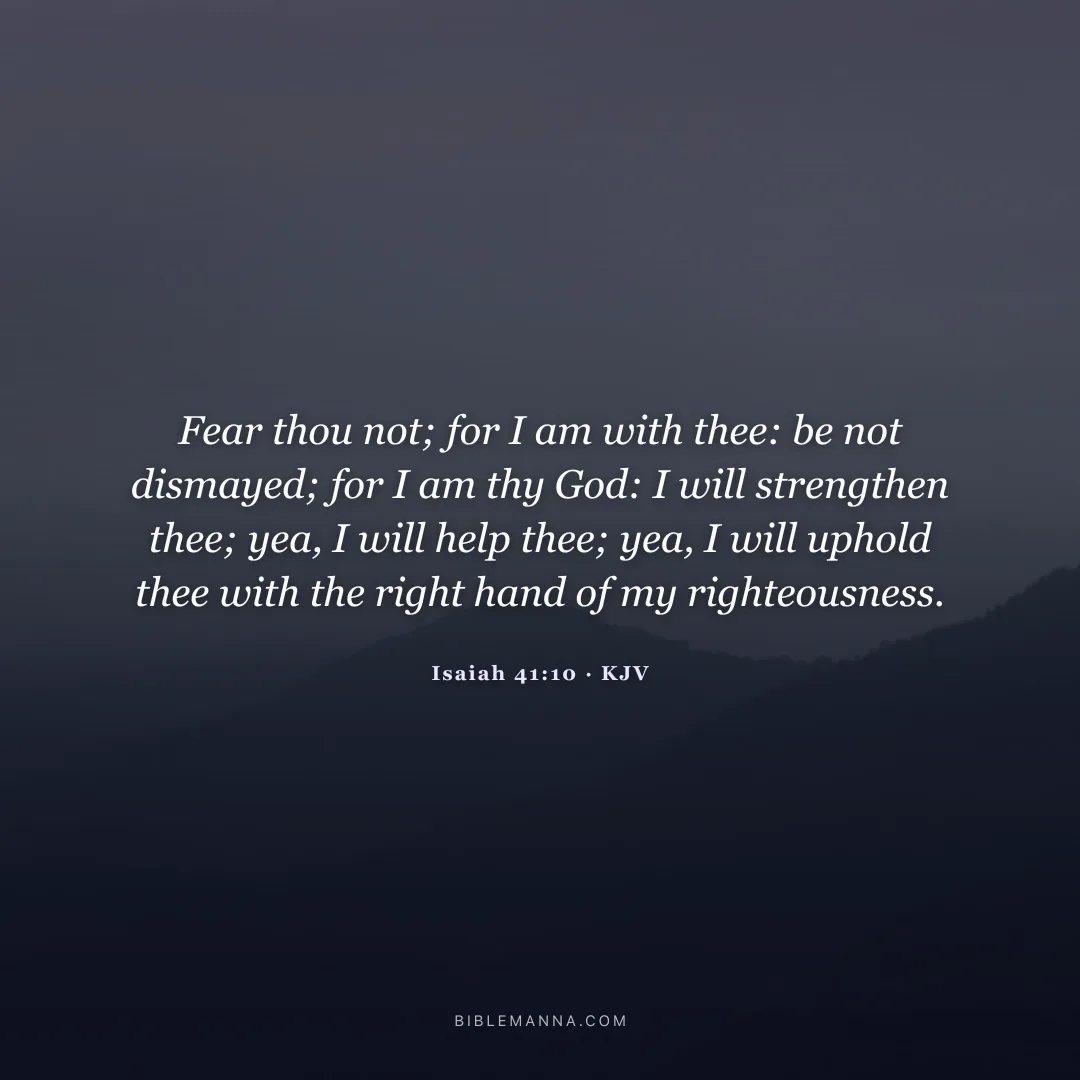
Isaiah 41:10 KJV
“Fear thou not; for I am with thee: be not dismayed; for I am thy God: I will strengthen thee; yea, I will help thee; yea, I will uphold thee with the right hand of my righteousness.”
Context & Meaning
God directly addresses anxiety with five interlocking promises: presence, identity, strength, help, and upholding, a comprehensive answer to every anxious thought.
Psalm 94:19 KJV
“In the multitude of my thoughts within me thy comforts delight my soul.”
Context & Meaning
The psalmist honestly describes an anxious, racing mind, and then testifies that God's comforts are capable of reaching in and bringing genuine delight even there.
Matthew 6:25-27 KJV
“Therefore I say unto you, Take no thought for your life, what ye shall eat, or what ye shall drink; nor yet for your body, what ye shall put on. Is not the life more than meat, and the body than raiment? Behold the fowls of the air: for they sow not, neither do they reap, nor gather into barns; yet your heavenly Father feedeth them. Are ye not much better than they?”
Context & Meaning
Jesus uses creation to argue against anxiety, if God clothes the grass and feeds the birds, how much more will He care for those made in His image and loved as His children.
Psalm 56:3 KJV
“What time I am afraid, I will trust in thee.”
Context & Meaning
A simple but powerful resolution, fear is acknowledged as real, but the psalmist immediately counters it with a deliberate act of trust in God.
John 14:27 KJV
“Peace I leave with you, my peace I give unto you: not as the world giveth, give I unto you. Let not your heart be troubled, neither let it be afraid.”
Context & Meaning
Jesus bequeaths peace as a legacy gift, a peace qualitatively different from what the world offers, one that directly addresses a troubled and fearful heart.
Isaiah 26:3 KJV
“Thou wilt keep him in perfect peace, whose mind is stayed on thee: because he trusteth in thee.”
Context & Meaning
Perfect peace is the result of a mind anchored on God rather than on circumstances, the quality of peace available is directly linked to where attention is focused.
Psalm 23:4 KJV
“Yea, though I walk through the valley of the shadow of death, I will fear no evil: for thou art with me; thy rod and thy staff they comfort me.”
Context & Meaning
Even in the darkest, most fear-filled passage of life, the psalmist finds that God's presence transforms terror into comfort, the valley's shadow cannot harm when God is near.
Frequently Asked Questions
What does the Bible say about anxiety?
The Bible directly addresses anxiety in multiple places. Philippians 4:6-7 commands casting all worry onto God through prayer with thanksgiving, promising supernatural peace. Matthew 6:25-34 has Jesus addressing anxiety about daily needs, pointing to God's reliable provision. 1 Peter 5:7 gives the simple instruction to cast all cares on God because He cares for us.
Is anxiety a sin according to the Bible?
The Bible commands us not to be anxious (Philippians 4:6, Matthew 6:25) and 2 Timothy 1:7 says God has not given us a spirit of fear. However, many Bible scholars distinguish between sinful anxiety (dwelling in worry, refusing to trust God) and natural anxiety (the emotional experience of threat or uncertainty). Jesus Himself experienced deep distress in Gethsemane (Matthew 26:38). The response to anxiety, turning it to God in prayer, is what Scripture calls us toward.
What is the best Bible verse to overcome anxiety?
Philippians 4:6-7 is widely considered the most comprehensive anxiety verse: "Be careful for nothing; but in every thing by prayer and supplication with thanksgiving let your requests be made known unto God. And the peace of God, which passeth all understanding, shall keep your hearts and minds through Christ Jesus."
How do I use the Bible to calm anxiety?
Practical approaches include: reading and meditating on specific anxiety scriptures (Philippians 4:6-7, Isaiah 41:10, Psalm 23), praying through your specific fears aloud, memorizing short verses like Psalm 56:3 to recall in anxious moments, and practicing thanksgiving even when worried (as Philippians 4:6 instructs).
What did Jesus say about worry and anxiety?
In Matthew 6:25-34, Jesus gave the most extended teaching on anxiety in the Gospels. He told His disciples not to worry about food, clothing, or their lifespan, pointing to God's care for birds and flowers as evidence of His attentiveness to greater human needs. He concluded with "Seek ye first the kingdom of God... and all these things shall be added unto you" (Matthew 6:33).