The Great Commission Meaning: What Matthew 28:19–20 Actually Commands

The Great Commission is Christ’s direct command to every believer, recorded in Matthew 28:18–20: go, make disciples of all nations, baptize them in the name of the Father, Son, and Holy Spirit, and teach them to obey everything he commanded. The central imperative is make disciples, not simply “go” or “convert.” GotQuestions summarizes it plainly: the main command is disciple-making, and Acts 1:8 complements it by adding Spirit-powered witness from your own neighborhood outward to the ends of the earth. Your next step is simple: identify one person in your life you can intentionally walk with in faith this week.
Three things to hold from the start:
- The command: Make disciples. Everything else describes how.
- The scope: All nations, all peoples, to the end of the age.
- The foundation: Christ’s authority grounds the mission; his presence sustains it.
Key Takeaways
The Great Commission’s central command is make disciples, grounded in Christ’s resurrection authority and sustained by his promised presence to the end of the age.
| Point | Details |
|---|---|
| One imperative, three means | “Make disciples” is the main command; going, baptizing, and teaching are the means. |
| Authority and presence bookend the mission | Matthew 28:18 grounds the mandate in Christ’s authority; verse 20 sustains it with his presence. |
| All five passages form one pattern | Matthew, Mark, Luke, John, and Acts together show proclamation, baptism, teaching, and Spirit-empowerment as a single missionary pattern. |
| Discipleship is ongoing, not a one-time event | The present participle “teaching” signals continuous formation toward obedience, not a single conversion moment. |
| Biblemanna supports lesson prep | Biblemanna’s topical verse collections on obedience, faith, and the Holy Spirit help small-group leaders build Great Commission lessons quickly. |
Table of Contents
- What does the Great Commission mean in Matthew 28:19–20?
- How do Mark, Luke, John, and Acts fill out the picture?
- Why does Matthew 28 begin with authority and end with presence?
- How do you actually fulfill the Great Commission today?
- Common misconceptions about the Great Commission
- How the early church enacted the Commission
- Scripture study resources to deepen your understanding
- Why biblical clarity on this passage matters more than you think
- Biblemanna helps you teach and live the Great Commission
- Sources
- FAQ
What does the Great Commission mean in Matthew 28:19–20?
Matthew places this scene on a Galilean mountain after the resurrection, the climactic moment of his entire Gospel. Jesus has conquered death; now he commissions his followers. The grammar of the Greek text is what makes the great commission meaning precise rather than vague.
NETBible’s notes on Matthew 28 confirm the key grammatical point: mathēteusate (“make disciples”) is the sole main imperative in verses 19–20. The three surrounding verbs — “going” (porēthentes), “baptizing” (baptizontes), and “teaching” (didaskontes) — are participles. Grammatically, they describe the means by which disciples are made, not three separate commands of equal weight.
The Greek grammar places the entire force of the Commission on one goal: make disciples. The participles are instrumental — they answer the question “how?” not “what?”
That distinction changes everything pastorally. A church that treats “go,” “baptize,” and “teach” as three parallel items on a checklist can complete all three and still never produce a disciple. The goal is a person who follows, obeys, and reproduces — and the Gospel Coalition’s Themelios article on discipleship reinforces this: mathēteusate implies teaching toward obedience and reproduction, not merely enrollment.
| Greek Term | Grammatical Role | Practical Import |
|---|---|---|
| mathēteusate | Main imperative | The goal: make disciples |
| porēthentes (going) | Aorist participle | The posture: move toward people |
| baptizontes (baptizing) | Present participle | The initiation: public entry into community |
| didaskontes (teaching) | Present participle | The ongoing process: forming obedience |
One manuscript note worth knowing: the trinitarian baptismal formula (“in the name of the Father and of the Son and of the Holy Spirit”) has strong manuscript consensus. Some scholars have raised questions about its liturgical development, but WorkingPreacher’s commentary on Matthew 28:16–20 cautions against reading the formula as an isolated proof-text. Its meaning is set by Matthew’s narrative, where it signals initiation into the life of the Triune God — not merely a ritual phrase.
How do Mark, Luke, John, and Acts fill out the picture?
Matthew 28 is the most cited Great Commission text, but it is not the only one. A TMSJ exegetical synthesis across all five commissioning passages shows a single missionary pattern running through them: proclamation, baptism, teaching, witness, and Spirit empowerment. Each passage adds a distinct angle.
| Passage | Distinctive Emphasis | How It Complements Matthew |
|---|---|---|
| Mark 16:15–18 | “Preach the gospel to all creation” | Broadens scope to all creation; adds signs accompanying proclamation |
| Luke 24:49 | Repentance and forgiveness preached to all nations; “clothed with power from on high” | Grounds commission in fulfilled prophecy; makes Spirit-empowerment explicit |
| John 20:23 | “As the Father has sent me, even so I am sending you”; Spirit breathed on disciples | Frames mission as participation in the Father–Son sending relationship |
| Acts 1:8 | “You will be my witnesses in Jerusalem, Judea, Samaria, and to the ends of the earth” | Provides the geographic and Spirit-powered framework for how Matthew’s command unfolds |
Acts 1:8 is especially useful for understanding sequence. The Spirit comes first; witness flows from that. Luke’s version in Acts does not replace Matthew’s command to make disciples — it shows the engine that powers it. A disciple-maker who skips prayer and dependence on the Spirit is working without the fuel the text assumes.
Why does Matthew 28 begin with authority and end with presence?
The structure of Matthew 28:18–20 is not accidental. Ligonier Ministries’ overview of Matthew 28 notes that the declaration of authority in verse 18 and the promise of presence in verse 20 form a theological bookend around the command. That structure carries weight.
“All authority in heaven and on earth has been given to me” is not a preamble. It is the basis of the Commission. Jesus does not say “go because it is a good idea” or “go because the world needs it.” He says go because he holds all authority. The mission is legitimate, unstoppable, and cosmic in scope precisely because the one who sends it has been raised and enthroned.
The closing promise, “I am with you always, to the end of the age,” forms an inclusio with Matthew 1:23, where Jesus is named Immanuel — “God with us.” Matthew opens and closes his Gospel with the same claim. That is intentional theology, not coincidence.
Key implications for how believers understand the Commission:
- Authority grounds the mandate. Missionaries and disciplers go not on their own initiative but under Christ’s commission. That removes both timidity and arrogance.
- The Trinitarian formula signals new identity. WorkingPreacher’s commentary treats baptism “in the name of the Father and of the Son and of the Holy Spirit” as initiation into participation in the Triune life — a new relational identity, not merely a rite.
- Presence sustains the mission. “I am with you always” is not a comfort verse for hard days alone. It is the promise that Christ himself accompanies every act of disciple-making, mediated through the Spirit.
- The end of the age sets the horizon. The Commission runs until Christ returns. There is no retirement clause.
How do you actually fulfill the Great Commission today?
Exegesis without application is just scholarship. Here is a reproducible framework for disciple-making that tracks the grammar of Matthew 28.
- Identify. Name one or two people in your life who are open to spiritual conversation. Disciple-making is relational before it is programmatic.
- Invite. Move toward them intentionally — a meal, a walk, a regular check-in. The participle porēthentes (“going”) implies movement, not waiting.
- Initiate. When someone comes to faith, baptism is the public, communal step of entry. Connect them to a local church body where that initiation is celebrated and witnessed.
- Train. Teach them to obey — not just to know. The Gospel Coalition’s Themelios study is clear that didaskontes in Matthew 28 points toward obedience, not information transfer. Use scripture memory, accountability, and regular reflection.
- Reproduce. The clearest sign that disciple-making is working is when the person you are mentoring begins mentoring someone else. That is the Commission’s built-in multiplication logic.
For local church settings, small groups are the most natural vehicle. A group of six to eight people meeting weekly around scripture, prayer, and shared life can move through all five steps without a seminary degree or a mission budget.
For global contexts, the same framework applies — but the “going” may mean crossing cultural, linguistic, or geographic lines. Western Seminary’s Transform resource makes the point that most believers can fulfill the Commission without ever leaving their city, by engaging neighbors, coworkers, and international students.

Pro Tip: The simplest indicator that your disciple-making is reproducing: ask the person you are mentoring whether they are having spiritual conversations with anyone else. If the answer is no after six months, the process has stalled at information and has not yet reached formation.
Prayer is not optional in this framework. Luke 24:49 and Acts 1:4–5 both show the disciples waiting in prayer before the Spirit came. Dependence on the Spirit is not a spiritual add-on — it is the precondition the New Testament assumes.
Common misconceptions about the Great Commission
A few errors show up repeatedly, and they are worth naming directly.
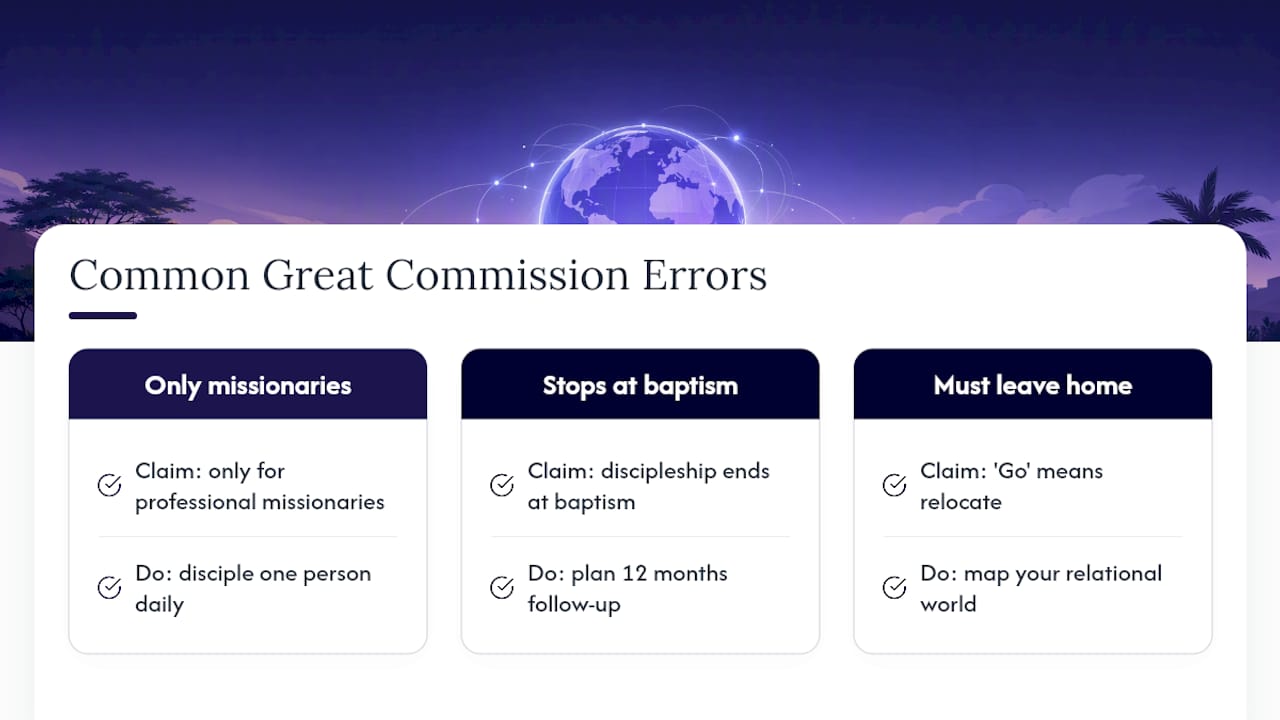
Misconception 1: The Great Commission is only for professional missionaries. The text addresses the eleven disciples, but they represent the whole church. Western Seminary’s Transform resource argues that ordinary believers in ordinary contexts are the primary agents of disciple-making. The Commission is not a job description for a specialist class.
Corrective step: Ask yourself who in your daily life you are intentionally discipling. If the answer is no one, start with one person.
Misconception 2: Discipleship ends at conversion or baptism. Baptism is initiation, not completion. The participle didaskontes (“teaching”) is present tense — ongoing, not finished. Discipleship is a lifelong process of formation toward obedience.
“Teaching them to observe all that I have commanded you” is not a one-time orientation session. The present participle signals continuous, ongoing formation — a relationship, not an event.
Corrective step: If you lead someone to faith, plan the next twelve months of intentional follow-up before you celebrate the conversion.
Misconception 3: “Go” always means leave home. Grammatically, porēthentes is an aorist participle that can be translated “as you go” — meaning in the course of ordinary life. International mission is real and necessary, but the Commission does not require relocation as its primary mode. Your neighborhood, workplace, and family are legitimate mission fields.
Corrective step: Map your relational world. Identify the people you already see regularly who do not yet know Christ.
How the early church enacted the Commission
The apostolic church did not wait for a formal program. Acts 2 shows baptism, teaching, fellowship, and prayer as the immediate response to Pentecost — a pattern that maps directly onto Matthew 28’s participles. Three thousand were baptized in a single day, then immediately incorporated into a teaching community.
By the second and third centuries, the church had developed formal catechesis: a structured period of instruction before baptism that could last up to three years. The Didache, one of the earliest post-apostolic documents, outlines a two-ways moral teaching followed by baptismal instruction. This was not bureaucracy — it was the church taking “teaching them to obey” seriously.
The Reformation brought catechesis back to the center after centuries of drift. Luther’s Small Catechism (1529) and Calvin’s Geneva Catechism (1542) were both attempts to fulfill the “teaching” participle at a congregational scale, putting doctrinal formation into the hands of ordinary households.
Historical practices still worth adapting today:
- Catechesis before baptism: A structured period of teaching and formation before public initiation, not just a one-Sunday class.
- Mentored discipleship: The early church’s practice of pairing new believers with mature ones for ongoing formation.
- Communal accountability: Small groups that hold one another to the “observing all that I commanded” standard.
- Sending with support: The apostolic pattern of sending missionaries in pairs (Acts 13:2–3) with prayer, commissioning, and ongoing connection to the sending community.
The TMSJ exegetical study shows this continuity between apostolic practice and later catechetical traditions — the church was not inventing new programs but extending the same Commission across new generations.
Scripture study resources to deepen your understanding
Preparing to teach the Great Commission well requires more than one passage. These verse collections and tools give you the raw material for a complete lesson.
- Bible verses on obedience: Directly supports the “teaching them to obey” dimension of Matthew 28:20. Pull three or four of these for a small-group discussion on what obedience looks like in practice.
- Bible verses on faith: Useful for the initiation and training phases of disciple-making; faith is the posture Matthew 28 assumes.
- Bible verses on encouragement: For disciplers who are tired or discouraged — the promise “I am with you always” belongs in this category.
- Biblemanna’s topical library: Covers baptism, the Holy Spirit, discipleship, and related themes with verse context and background — good for building a teaching outline quickly.
Mini-lesson template for small groups (15–20 minutes):
- Read Matthew 28:18–20 aloud together (2 minutes).
- Exposition (5 minutes): Explain that “make disciples” is the main command and the other three verbs describe how. Use the Greek table from this article if helpful.
- Reflection question (5 minutes): “Who in your life are you intentionally discipling right now? What is one obstacle?”
- Application task (3 minutes): Each person names one person they will have a spiritual conversation with before the next meeting.
For readers who want to go deeper into the biblical background on “all nations” language and the Gentile mission, the Spirit of His Mouth study on Gentiles in the Bible provides useful background on how that phrase functions across the Old and New Testaments.
Why biblical clarity on this passage matters more than you think
There is a version of the Great Commission that gets preached often and practiced rarely: the version where “go and make disciples” becomes a slogan on a church banner rather than a description of how any specific person in the congregation spends their Tuesday. That gap between declaration and practice is not a motivation problem. It is usually a clarity problem.
When believers understand that the grammar of Matthew 28 puts the entire weight of the Commission on disciple-making — not on going, not on baptizing, not on teaching as isolated acts — the question shifts from “am I doing missions?” to “am I making disciples?” That is a harder question, and a more honest one.
The promise “I am with you always” is not a consolation prize for people who tried and failed. It is the active, ongoing presence of the risen Christ in every conversation, every mentoring relationship, every small group that opens a Bible together. The Commission is not a burden laid on the church from outside. It is an invitation into the work Christ himself is already doing.
Pro Tip: When you feel the weight of the Commission as obligation rather than invitation, re-read verse 18 before verse 19. The authority is his. The presence is his. You are not the engine — you are the instrument.
Biblemanna helps you teach and live the Great Commission
Preparing a Great Commission lesson from scratch can take hours. Biblemanna cuts that time significantly by organizing scripture by theme, so you can pull a focused verse set on discipleship, obedience, baptism, or the Holy Spirit in minutes rather than searching passage by passage.

The topical verse index at Biblemanna covers more than 50 themes with full verse text and context for each entry. For a small-group leader preparing a four-week series on Matthew 28, that means you can build each session around a curated scripture set rather than starting from a blank page. The editorial explainers on biblical topics add teaching background on subjects like baptism and the Holy Spirit, so you arrive at your group with more than a verse list. Browse the Biblemanna topical library and start building your next lesson today.
Sources
- NETBible: Matthew 28
- The Missionary’s Guide to the Great Commission (TMSJ exegetical analysis)
- The Gospel Coalition — ‘Go therefore and make disciples’ (themelios article)
- WorkingPreacher commentary on Matthew 28:16–20
- Gotquestions
FAQ
What are the three commands of the Great Commission?
Grammatically, there is one main command: “make disciples.” Going, baptizing, and teaching are participles that describe the means, not three parallel commands. NETBible’s notes on Matthew 28 confirm this reading.
What is the biblical meaning of “commission” in this context?
A commission is a formal charge or mandate given by one with authority to those who act on their behalf. In Matthew 28, Jesus issues the charge from a position of resurrection authority — “all authority in heaven and on earth has been given to me” — making the Commission both binding and empowered.
How do we fulfill the Great Commission?
By making disciples: moving toward people intentionally, initiating them into the faith community through baptism, and teaching them ongoing obedience to Christ’s commands. GotQuestions notes that Acts 1:8 adds the Spirit-empowered dimension, moving from local witness outward to all nations.
Is the Great Commission only for missionaries?
No. The text addresses all disciples, and the “going” participle can be read as “as you go” in ordinary life. Western Seminary’s Transform resource argues that most believers fulfill the Commission in local, everyday contexts without international relocation.
What does “to the end of the age” mean in Matthew 28:20?
It means the Commission runs until Christ’s return, with no expiration date. The promise of Christ’s presence is co-extensive with the duration of the mission — he accompanies every generation of disciple-makers until history reaches its conclusion.